
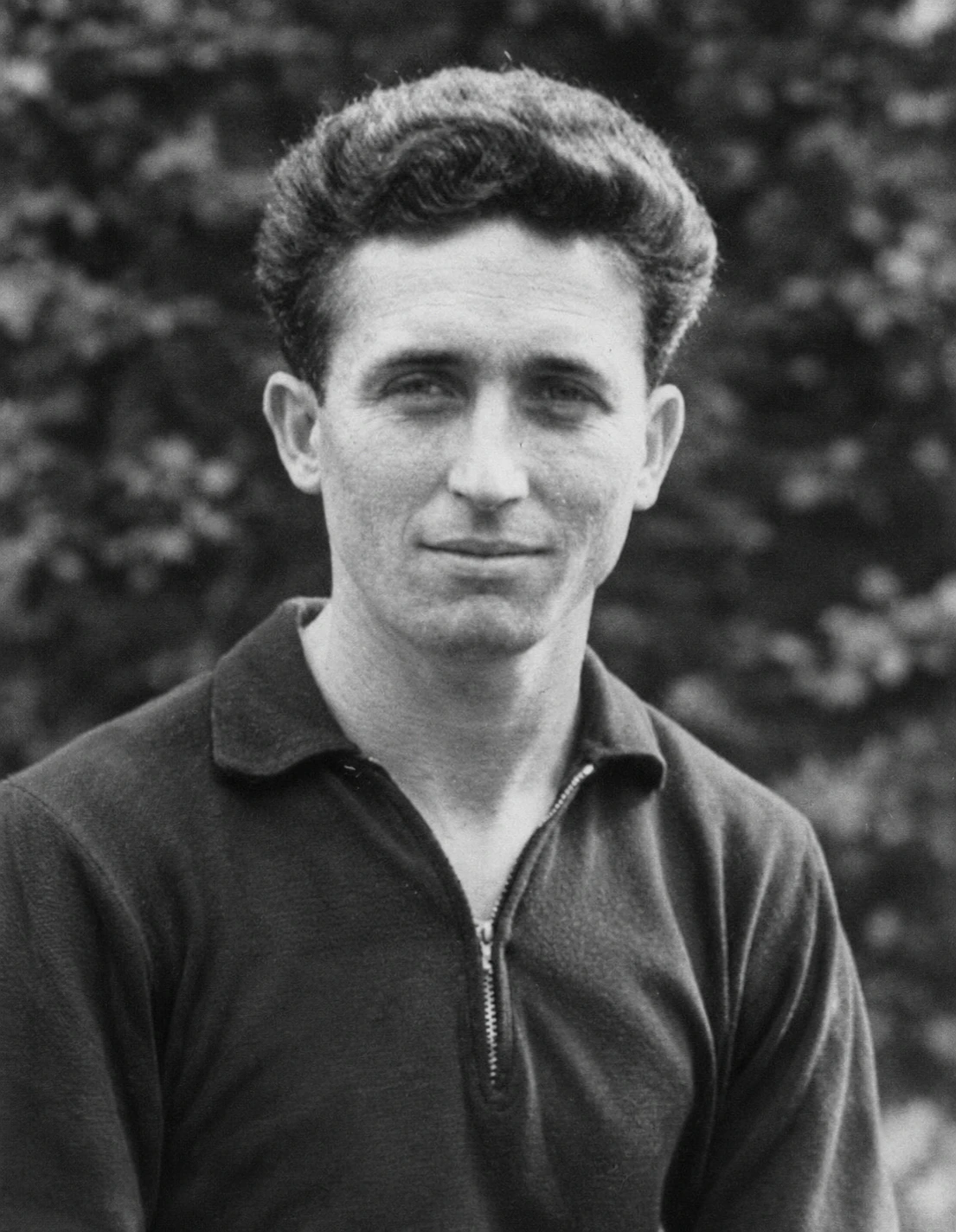
Jiří Kinský
He escaped from Vajnory to Austria on 24.5.1959 in a Šohaj VT-125 glider.
A N A L Y S I S
of the escape of aircraft VT-125 / OK-0657, flown by pilot Kinský Jiří of Bratislava Regional Aeroclub.
On 24.5.1959, aircraft VT-125 / OK-0657, flown by Kinský Jiří, escaped abroad. Following investigation and witness statements, the commission reached the following conclusions:
On 24.5.1959, flying was organised as planned at Bratislava-Vajnory Regional Aeroclub airfield. Only gliding took place in the morning, directed by Class II volunteer instructor First Lieutenant Šumpík Stanislav, currently deputising for the regional gliding instructor in supervising glider training at Vajnory. The regional instructor is currently on military exercises.
Flying was organised according to the flying order and planning table.
At approximately 15.23, a glider escaped across the border. The situation at the airfield was as follows:
Pilot Kinský Jiří took off at 14.40 in VT-125 / OK-0657, tasked with searching for thermals for one hour in the Vajnory airfield area. He was towed to 500 m above ground. After releasing from the tug, he searched for lift east of the airfield near Šúr forest, gradually moving along the southern edge of the airfield towards Rača to the northwest.
Witnesses stated that he climbed to 1.500–1.800 m there, then crossed the Czechoslovak-Austrian border and landed at Vienna-Schwechat airfield.
He crossed the border while still scheduled to be thermal soaring: he had launched at 14.40, was due to land at 15.40, and was observed crossing at approximately 15.23.
The airfield duty team’s actions were as follows:
When Kinský launched, three gliders were airborne: two VT-109s flying circuits and one LG-130 Kmotr above the airfield. Several more launches followed, including comrades Boroš and Morovianová in a VT-109, flying roughly in Kinský’s area.
As the Boroš–Morovianová crew needed to land, the flying supervisor had the landing signal laid out for all aircraft at about 15.15. The displayed landing signal applied to all crews. Duty-team members stated that Kinský was then out of sight, but attached no particular significance to this: cloud obscured the glider, and they assumed he could see the airfield and signals and would obey the landing order. About eight to ten minutes later, Major Pecho received an instruction from Ivanka airfield’s dispatch service to bring all aircraft down and stop operations. At the same time, dispatch reported an unidentified glider crossing the state border towards Austria and asked whether it was a glider belonging to Bratislava Regional Aeroclub. After the landing signal was set out, all airborne aircraft except Kinský’s VT-125 landed. When he failed to land at the scheduled time, it became clear that his aircraft had crossed the border. At about 16:40, the civil dispatch service reported that the glider with Kinský aboard had landed at Schwechat.
A detailed investigation of the entire case by the Zväzarm Municipal Committee’s commission and the Regional Administration of the Ministry of the Interior established the following:
Pilot Kinský Jiří had been preparing his escape for some time, as indicated by these facts:
1/ A notebook left in his bag at the airfield contained several Swiss and Austrian addresses. The Regional Administration of the Ministry of the Interior is currently investigating this.
2/ A map at a scale of 1:1.500.000 was found in his flat. On its reverse was a graphical pre-flight plan showing distances, heights and gliding range for the VT-125 and VT-425. The pre-flight plan indicates an attempted escape, as it addresses both altitude and weather conditions on the Bratislava–Schwechat route. This graphical preparation is included as an appendix.
3/ The above-named pilot made one winch-launched flight during the morning, which gave him an opportunity to establish the actual weather conditions and also to ascertain that no standby aircraft for protecting the state border were ready at the designated parking positions at Ivanka airfield. The commission further expresses the view that he did not attempt to escape in the morning because operations were then supervised by salaried instructors, but reserved his escape for the afternoon, when training was supervised by volunteers and flying was limited to gliders.
Regional Aeroclub chief Lt. Col. Mäsiar Anton also bears responsibility for the incident, having failed to enforce directive 03070/59 and the flying regulations on operational supervision consistently. He permitted volunteer-run operations at Vajnory in which the prohibition on the flying supervisor flying was not observed.
Flying supervisor comrade Šumpík also erred by conducting pupil-pilot flight checks while acting as flying supervisor.
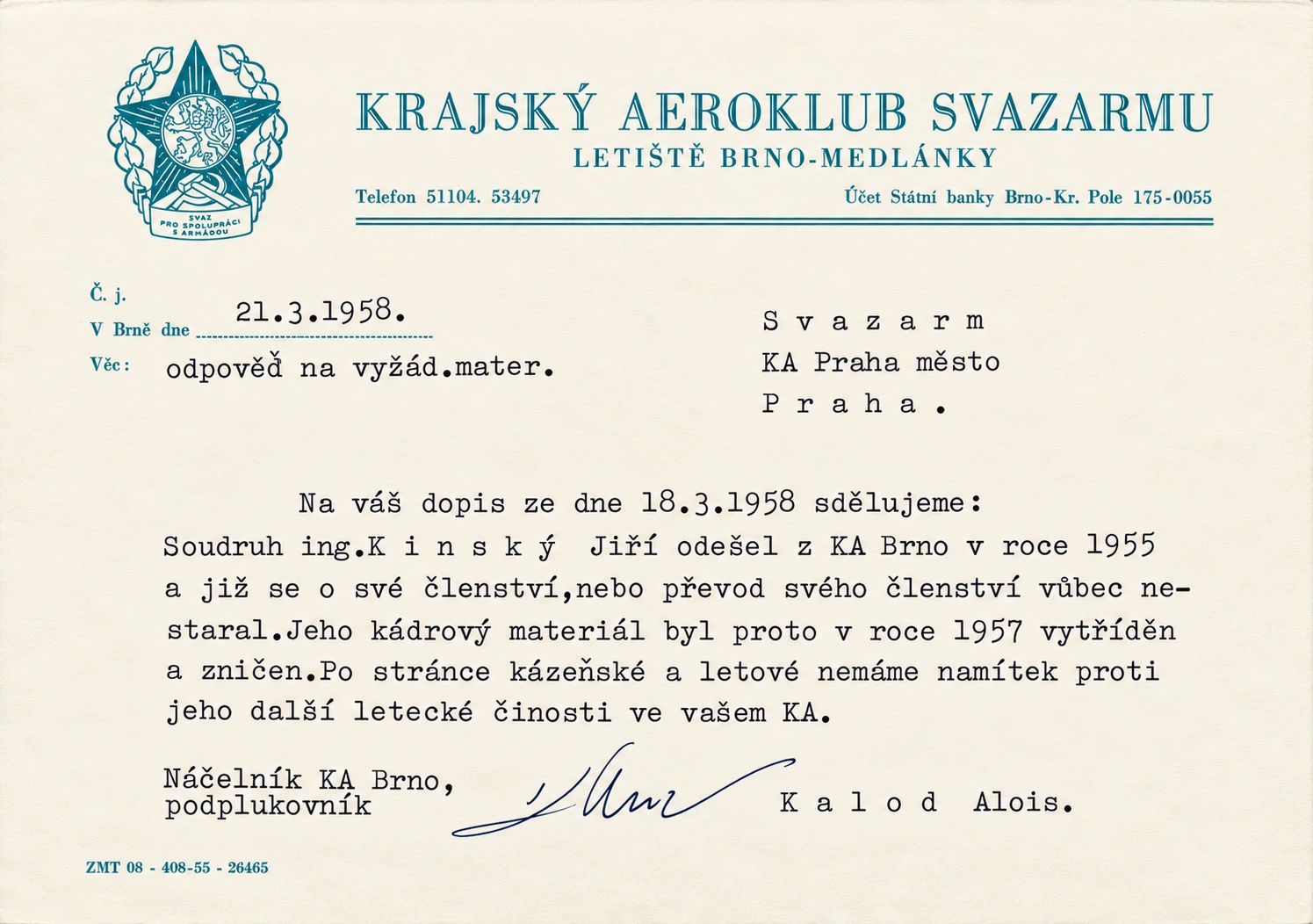
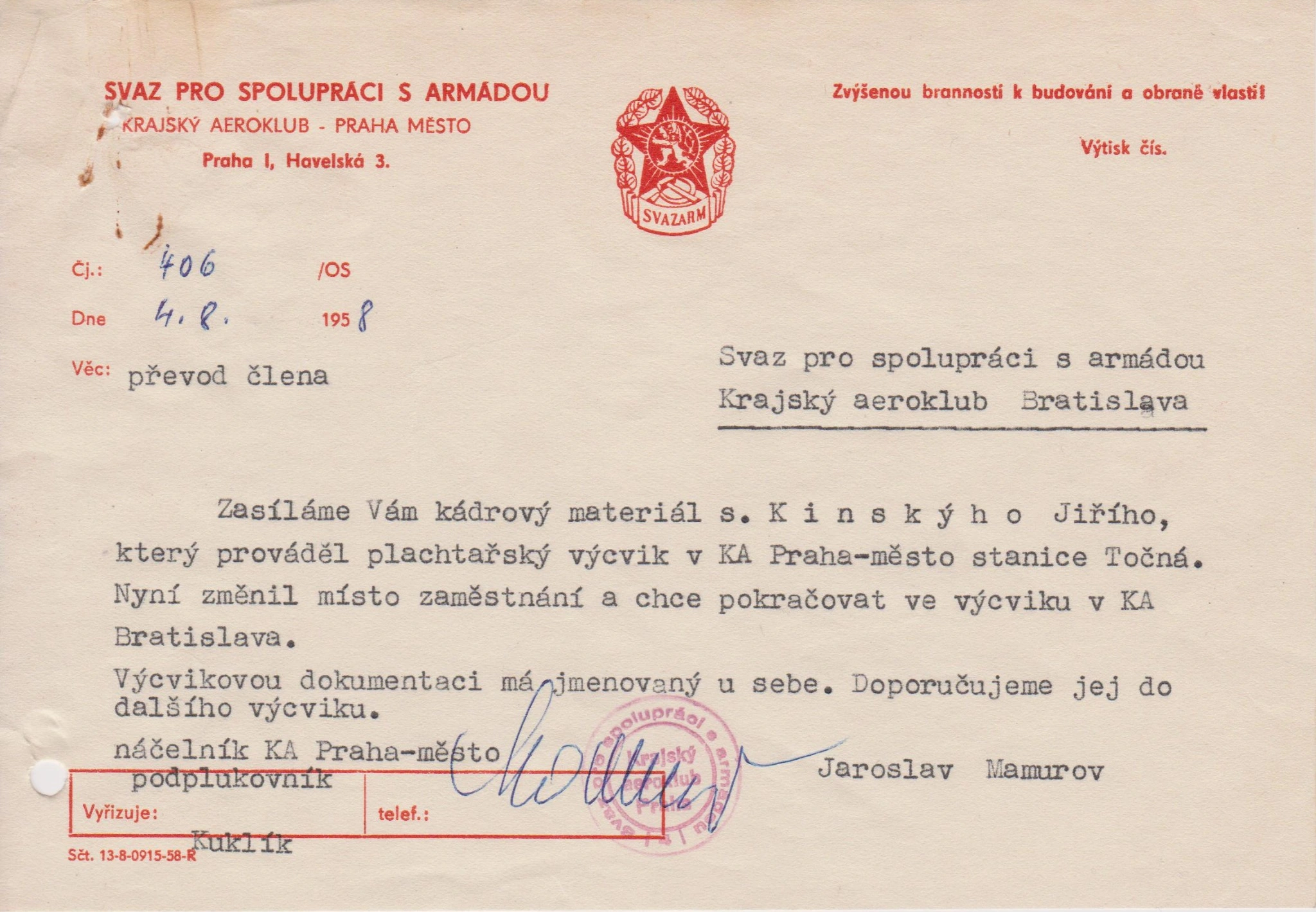
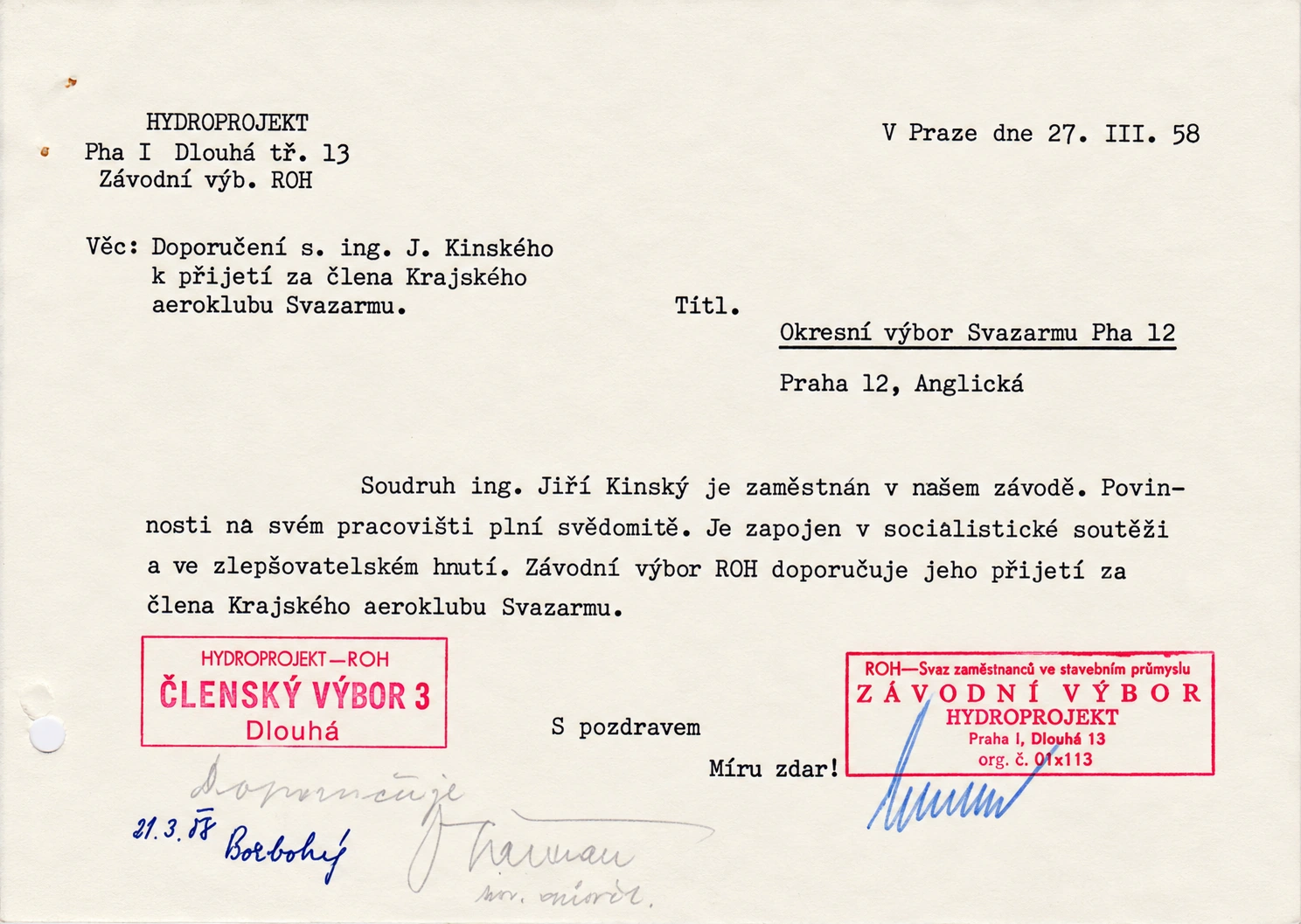
These persons are not directly responsible for the incident, since Kinský Jiří was known at the Regional Aeroclub as an energetic member with a good work ethic, also confirmed by his workplace and Prague-City Regional Aeroclub.
Vetting under order 03070/59 revealed no shortcomings. His personnel file was in order. All assessments were very good and recommended him for further flying. The municipal and regional Zväzarm vetting commission recommended his approval to the Regional Committee presidium, which approved him on 30.4.1959.
At his workplace, the above-named man had a reputation as a very good and conscientious employee who conscientiously fulfilled his duties. His workplace assessment dated 20.4.59 states that Party and personnel vetting had cleared him to work in any part of the state apparatus. Neither at his workplace nor at the airfield had any unusual character defects or unusual behaviour been observed in him that might suggest even a slightly unfavourable attitude towards our political system.
Following the 03070/59 checks, nothing in Kinský’s overall behaviour gave the slightest reason to suspect that he might escape abroad. The flying supervisor and entire airfield team placed this trust in him.
The commission proposes the following future measures:
1/ Ban all arrivals at Vajnory, Dunajská Streda and Holíč airfields from all Regional Aeroclubs, except flights by higher authorities and official flights by Regional Aeroclub employees.
2/ Revise Vajnory’s airfield rules and flying areas so all aircraft can be observed; permit only operations allowing every aircraft to be watched. Report any aircraft disappearing from sight to dispatch.
3/ Do not permit operations without a telephone connection between the launch point and the guardroom.
4/ Recheck the vetted membership of Bratislava Regional Aeroclub under 03070/59 and exclude anyone who does not fully meet the criteria from further membership.
5/ Do not allow members of other Regional Aeroclubs to fly as guests at Bratislava Regional Aeroclub airfield.
Bratislava, 30 June 1959.
Commission:
Lt. Col. Šoška Anton
Otokar Zajko
Kučera Ján – Regional Administration, Ministry of the Interior
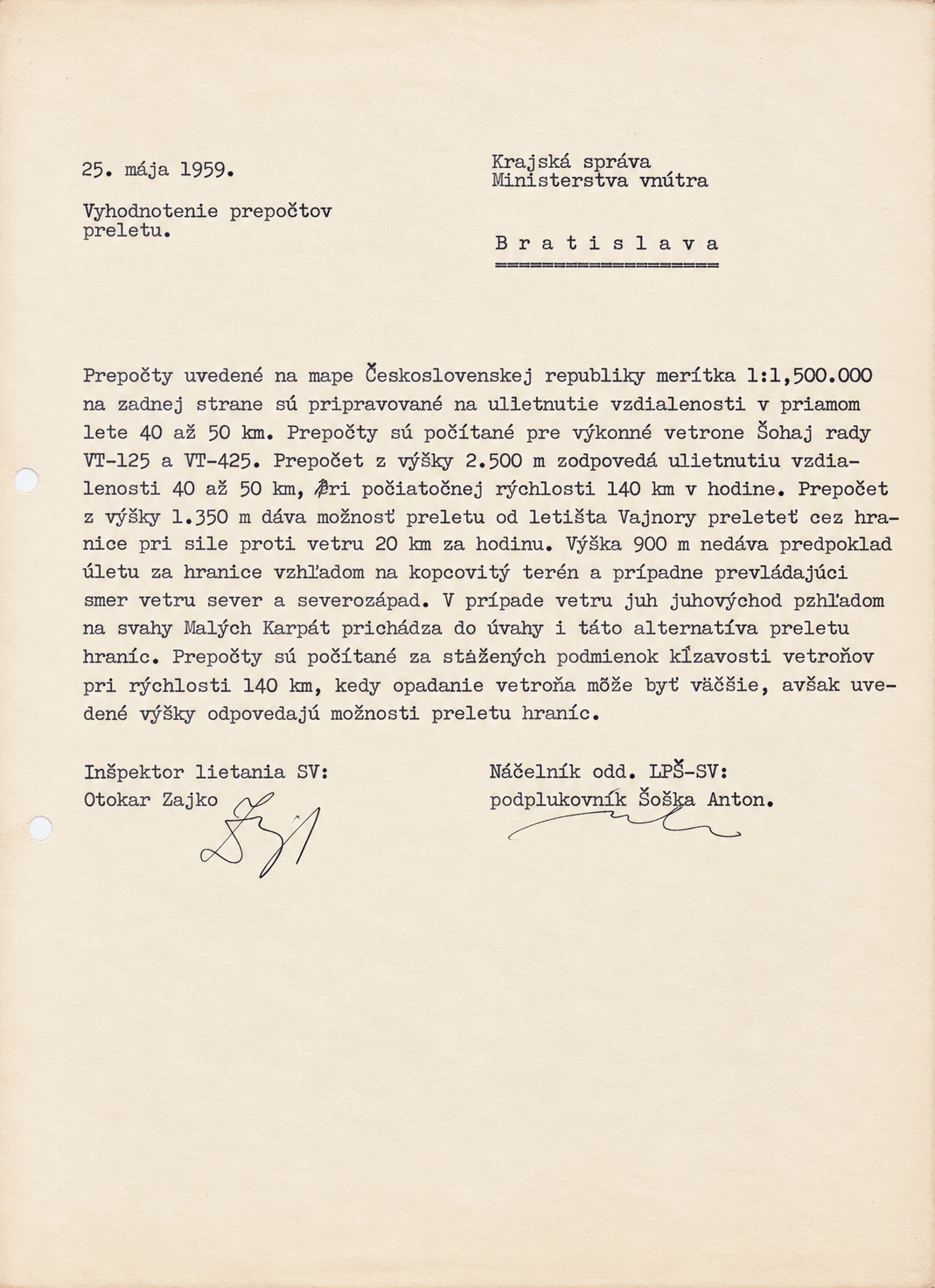
Transcript of the document dated 25 May 1959
Evaluation of cross-country flight calculations.
Regional Administration of the Ministry of the Interior, Bratislava
The calculations on the reverse of the map of the Czechoslovak Republic at a scale of 1:1.500.000 were prepared for covering a distance of 40 to 50 km in straight flight. The calculations concern high-performance Šohaj sailplanes of the VT-125 and VT-425 series.
The calculation from an altitude of 2,500 m corresponds to covering a distance of 40 to 50 km at an initial speed of 140 km/h. The calculation from an altitude of 1,350 m above Vajnory indicates that crossing the border into Austria would be possible even with a headwind of 20 km/h.
An altitude of 900 m offers no prospect of escaping across the border, given the hilly terrain and the possibly prevailing northerly and northwesterly winds. In a south-southeasterly wind, this alternative for crossing the border also comes into consideration owing to the slopes of the Little Carpathians.
The calculations account for the sailplane’s increased sink rate at a speed of 140 km/h; nevertheless, the stated altitudes would allow an actual crossing of the border.
SV Flight Inspector: Otokar Zajko
Head of the LPŠ-SV Department: Lieutenant Colonel Šoška Anton
Note: The Slovak transcription preserves the original wording of the document, including its period spelling and expressions. The map scale and sailplane designations have been transcribed as they appear in the original. The text above is an English translation.