
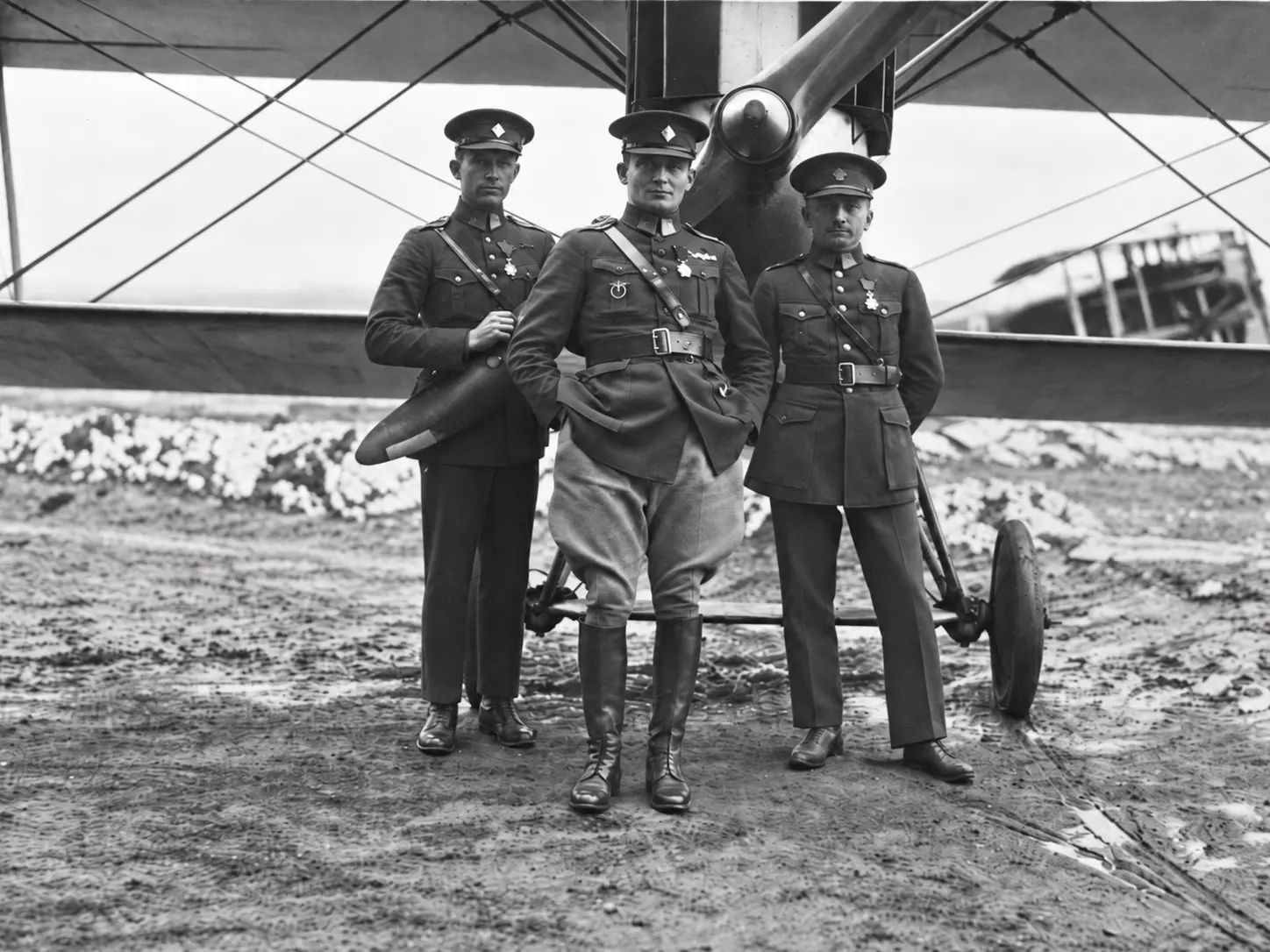
maj. Vilém Stanovský
(27 March 1896, Moravská Ostrava – 11 July 1972, Prague)
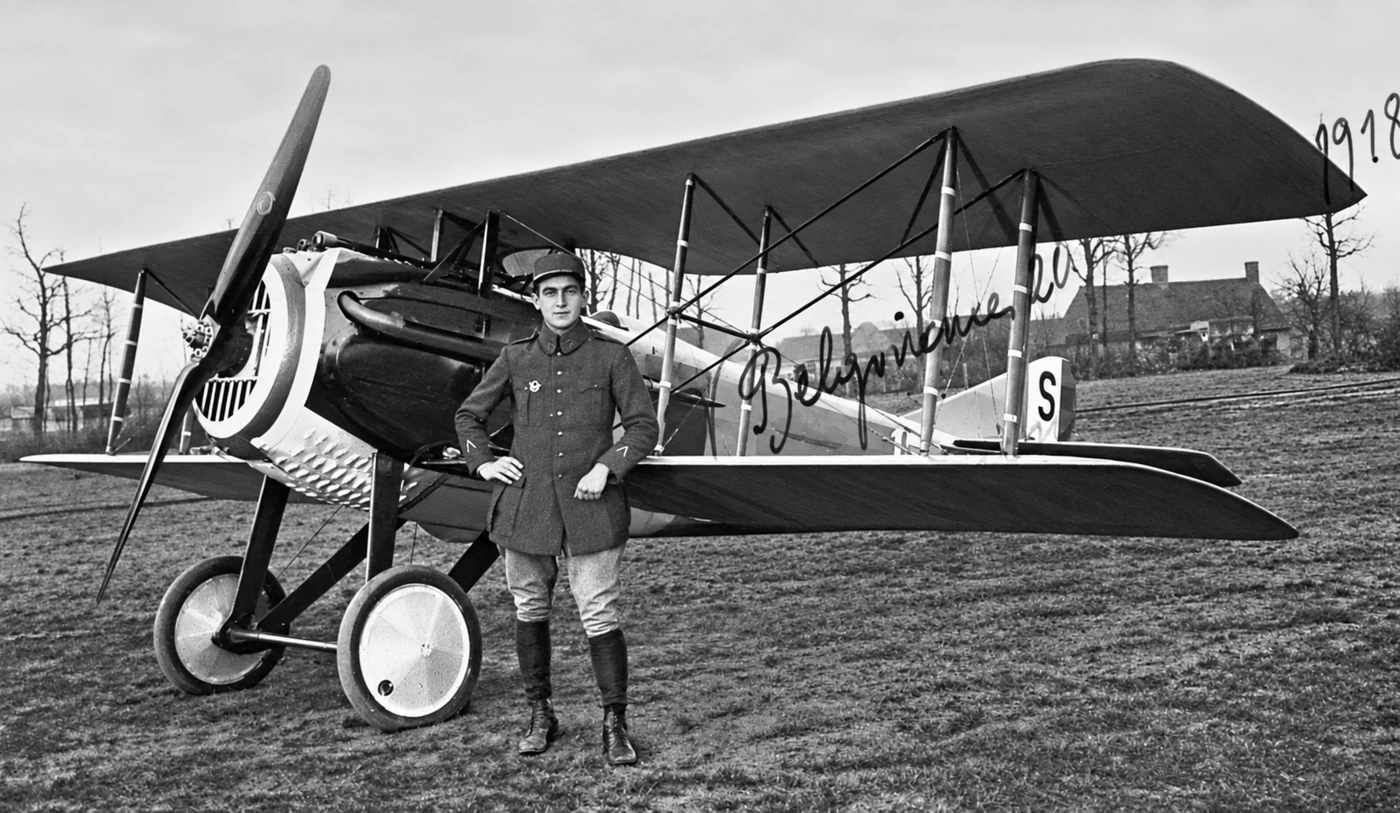
After the outbreak of the First World War, Vilém Stanovský volunteered for the French Foreign Legion and joined the Czech Nazdar Company. He fought with it on the Western Front and was wounded in the Battle of Arras on 9 May 1915.[1][2]
While convalescing in Lyon in September 1915, he met M. R. Štefánik, who was looking among Czech soldiers for volunteers for a planned Czech aviation unit. Stanovský volunteered for aviation, but his application was not processed before he had to return to the front, where he continued to fight as an infantryman.[1][2]
In August 1917, Stanovský entered the French Army flying school at Dijon. He continued his pilot training at Miramas, followed by advanced training at Pau, aerial gunnery school at Cazaux and ground-attack pilot school at Perthes.[1]
At the turn of 1917 and 1918, he thus completed progressive pilot and combat training under the French system for preparing military airmen. On 8 May 1918, he received French FAI pilot certificate no. 13230.[1]
He completed fighter training in the spring of 1918 and joined the operational fighter unit SPA 158, equipped with SPAD VII and SPAD XIII aircraft, in early August.[1][2] He flew combat missions on these aircraft over the Western Front. On 8 November 1918, he was shot down over Ghent while fighting German Fokker D.VIIs; he crashed his SPAD VII during the forced landing and suffered a spinal injury.[1][2]
Video about Vilém Stanovský. Source – YouTube.
Building Czechoslovak military aviation
After the creation of Czechoslovakia, he continued in military aviation service. From April to June 1919, he helped retrain Czechoslovak airmen on French aviation equipment. From August 1919 to August 1920, he commanded the Flying School in Prague and at the same time became the first commander in the history of Kbely airfield.[1]
From August 1920, he was assigned to the Ministry of National Defence for the purchase of aircraft in France. In January 1921, he took charge of practical flight training at the Czechoslovak Central School of Aeronautics in Cheb. From March 1921 to November 1922, he was deputy to the school’s French commander, maj. Personne, and assumed command after his departure. He commanded the Aeronautical Training Establishment in Cheb from November 1922 to November 1923.[1]
On 28 October 1923, he was permanently awarded the field pilot badge.[6]
Vajnory and Aviation Regiment 3
After leaving Cheb, his life from 1923 to 1928 was closely connected with Slovakia and Aviation Regiment 3 of gen. M. R. Štefánik. He served in the regiment successively as a squadron commander, group commander and finally regimental commander.[1] In 1926 he is documented as commander of the regiment’s II Group at Vajnory, and in 1927 and 1928, as a major, he was entrusted with command of the entire regiment.[1][6]
In 1926, together with mechanic František Šimek, he completed a long-distance promotional flight in the Aero Ab-11.17, registration L-BUCD. They flew over 23 countries in Europe, North Africa and Asia Minor, covering 15,070 km and spending 91 hours and 52 minutes in the air.[3] The flight was an important promotion for both Czechoslovakia and its aviation industry.[1][3]
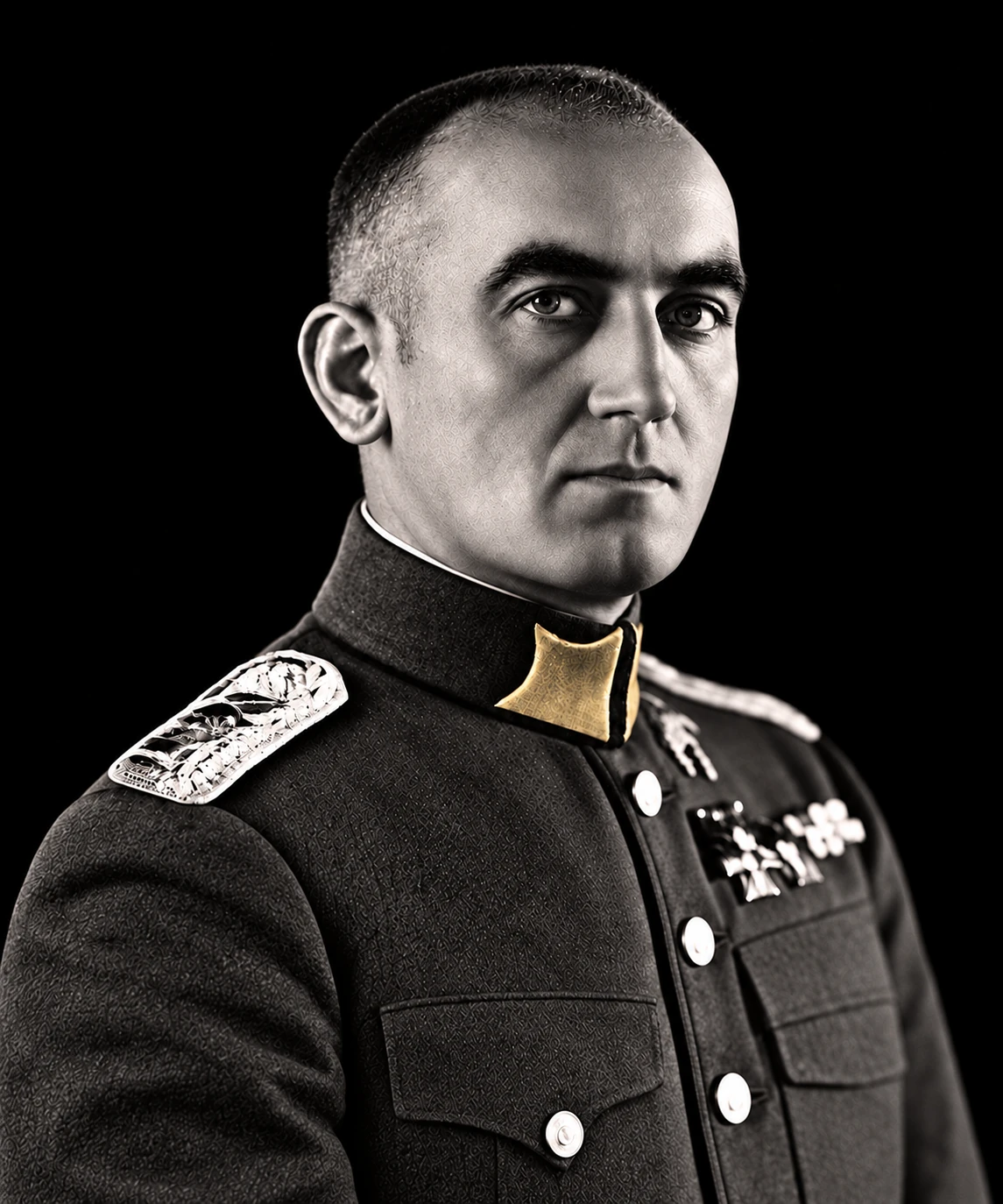
After leaving Aviation Regiment 3, Stanovský continued to improve his military and professional qualifications. He taught at military schools and courses and served at the Military Aviation Study Institute (VLÚS), later incorporated into the Military Technical and Aviation Institute (VTLÚ) at Letňany.[1]
In 1934, he assumed command of bomber Aviation Regiment 6 in Prague-Kbely. For several months that year, he was also temporarily entrusted with command of its superior Aviation Brigade. He then commanded Aviation Regiment 6 until the dissolution of Czecho-Slovakia in 1939.[1]
An important chapter of his service was the introduction of the modern Soviet Tupolev SB high-speed bomber into Czechoslovak military aviation. In 1937–1938, these aircraft were purchased from the Soviet Union and received the designation Avia B-71 in Czechoslovakia.[1][4]
Stanovský led a mission of Czechoslovak pilots, tasked with familiarising themselves with the new bomber, retraining crews and taking delivery of the first aircraft.[1][2] The first stay in the USSR was devoted mainly to retraining because the prepared aircraft could not yet be accepted. On a later journey in February 1938, the Czechoslovak crews took delivery of the aircraft and flew them to Czechoslovakia.[1][2]
Czechoslovak aviation introduced the Soviet Tupolev SB bombers under the designation B-71. A licence was also acquired for their domestic manufacture by Aero, Avia and Letov, but production had not advanced far enough before the occupation in March 1939 for a single licence-built aircraft to be completed for the Czechoslovak air force.[4][5] The aircraft used by Czechoslovak aviation before the occupation therefore came from the Soviet Union.[4]
Aviation Regiment 6 was among the units equipped with B-71 bombers. Stanovský also commanded it during the mobilisation of September 1938.[1][4]
The breakup of Czecho-Slovakia and the German occupation of the Czech lands in March 1939 ended the chapter of Stanovský’s life connected with building and serving in the military aviation of the First Czechoslovak Republic.[1]
Sources
[1] Jiří Rajlich: Generál Vilém Stanovský / 27. 3. 1896, Moravská Ostrava – 11. 7. 1972, Praha. Military History Institute Prague.
[2] Otto Janka: Generál Stanovský: příběh legionáře a letce a také příběh o zapomenuté ctnosti. Military History Institute Prague.
[3] Letoun Aero Ab-11.17, výr. č. 17. Military History Institute Prague.
[4] Čsl. bombardér B-71. Military History Institute Prague.
[5] Směrové kormidlo bombardovacího letounu Avia B-71. Military History Institute Prague.
[6] Vilém Stanovský. Association for Military Memorial Sites.