
Military aviation accidents
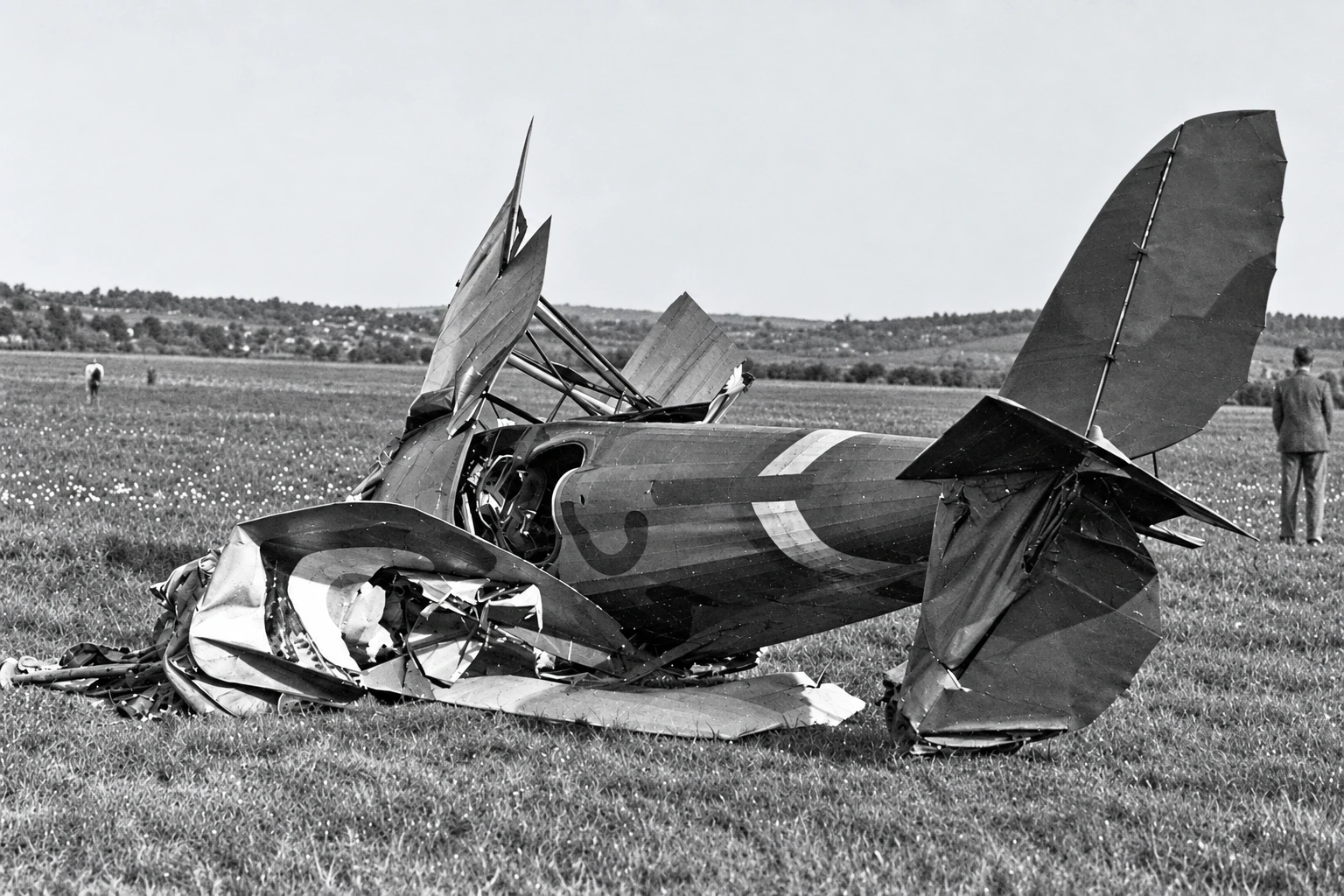
This overview covers Air Regiment 3 accidents from the airfield’s foundation until the division of Czechoslovakia on 14 March 1939, and a subsequent military accident at Vajnory on 6 May 1939.
At the airfield and in its immediate surroundings
| Date | Aircraft | Pilot / crew | Event |
|---|---|---|---|
| 9. 5. 1920 | SPAD S.XIII C.1 No. 10.279 | Capt. Georges Marcel Lachmann | Landing accident in fog at Vajnory; the aircraft was repaired. It was the same SPAD in which he had arrived on 4 June 1919. |
| 25. 5. 1920 | Salmson 2 A.2 No. 4380 | Severin Dřímal, Jan Prinz | Airfield crash and fire; both men died. |
| 26. 5. 1920 | SPAD S.VII, number unknown | Georges Marcel Lachmann | Another crash with minor injuries. The location is uncertain: Nitra or Bratislava-Vajnory. |
| 6. 5. 1924 | SPAD XIII No. 9157 | Emanuel Tichý | The aircraft overturned on landing and was written off. |
| 17. 5. 1927 | Avia BH-21.50 | Ota Šubrt, Air Regiment 3 | In-flight fire; forced landing in marshes about 3 km from Vajnory; the pilot was injured. |
| 13. 7. 1933 | Avia Ba-33.17 | Lt. Col. Ladislav Syka, 37th Squadron, Air Regiment 3 | Crash near Vajnory, minor injuries; probably a stall. |
| 10. 7. 1934 | Avia Ba-33.38 | Sgt. Ján Hergott | His harness came undone during aerobatics. He parachuted to safety; the aircraft crashed about 1 km southwest of the airfield. |
| 5. 9. 1935 | Avia B-33.2 or .4 | probably Lt. Josef Kloboučník, 38th Squadron, Air Regiment 3 | The aircraft was written off after the crash; its serial number is uncertain. |
| 30. 5. 1936 | Avia B-534.95 | Lt. Zdeněk Stahl, 37th Squadron, Air Regiment 3 | Landing crash; Sgt. Bohumil Pelcl rescued him from the burning aircraft. |
| 19. 5. 1937 | Avia B-534.156 | Lt. Alois Růžička, 39th Squadron, Air Regiment 3 | Failed to recover from a spin during aerobatics and crashed onto the airfield; killed. |
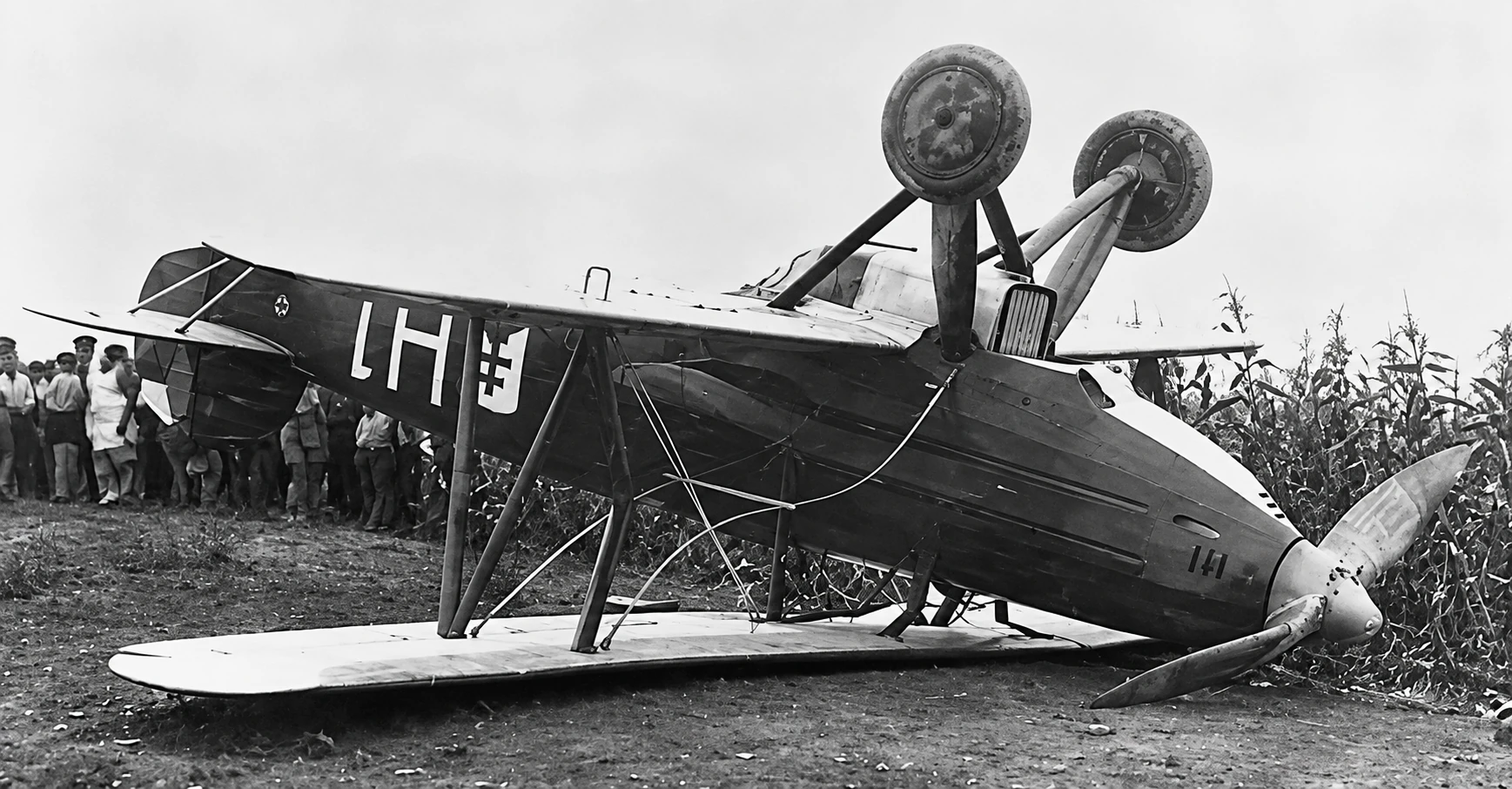
| 27. 8. 1937 | Avia B-534.141 | Lance Cpl. L. Světlík, 38th Squadron, Air Regiment 3 | The aircraft overturned during an unsuccessful landing; it returned to service after repairs. |
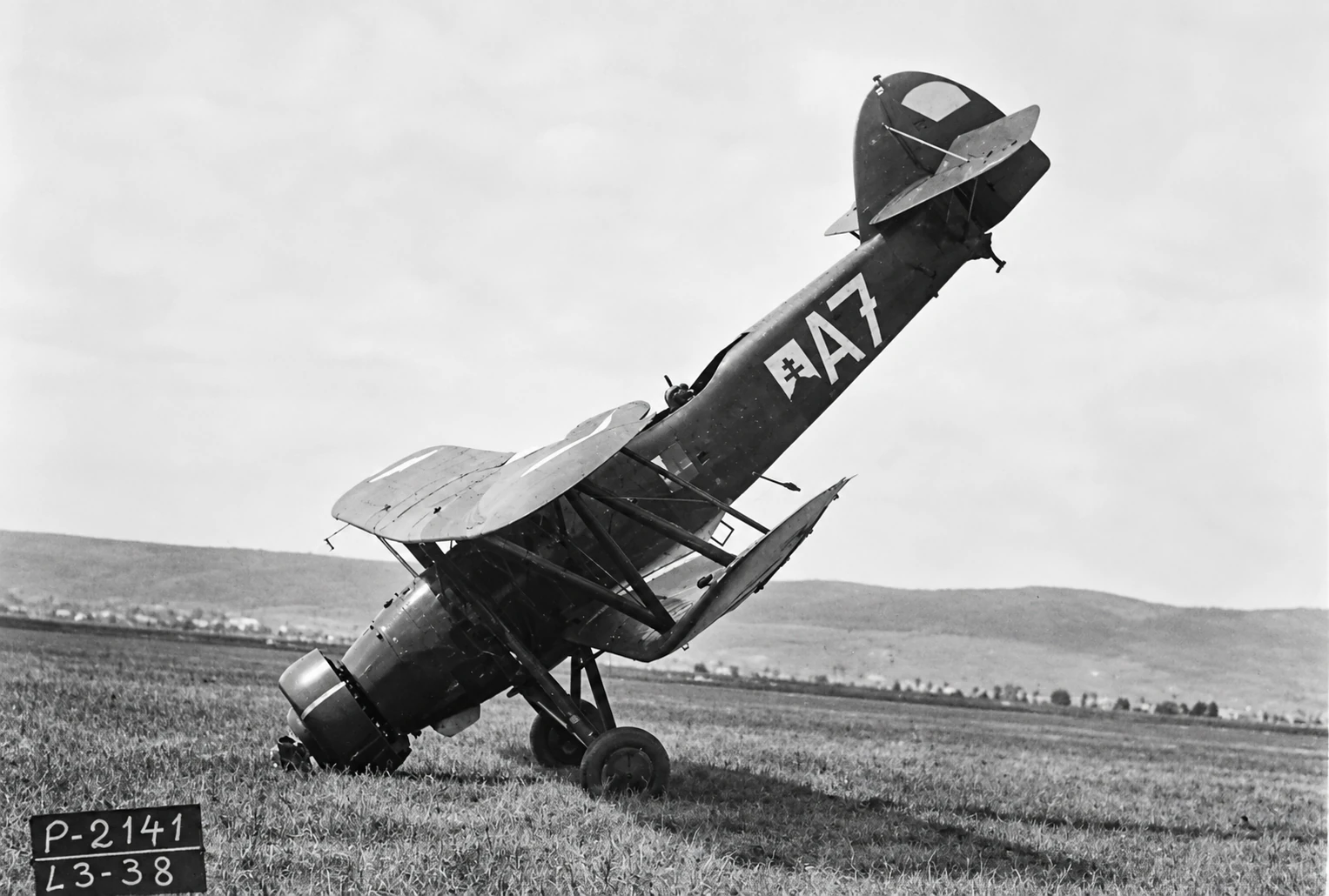
| 21. 8. 1938 | Letov Š-328.163 | — | The accident is documented by a photograph; the pilot and circumstances remain unverified. |
| 6. 5. 1939 | Avia-Fokker F.VIIb-1 / OK-OUA | — | Military accident at Vajnory. |
Crash of Avia-Fokker F.VIIb-1 / OK-OUA
On 6 May 1939 at approximately 18.25, the three-engined Avia-Fokker F.VIIb-1 / OK-OUA crashed near Vajnory airfield. It was then in military use, and the flight was a check following acceptance and registration. The aircraft had been inspected before departure, and contemporary records describe all three Walter Castor engines as serviceable.
After a test flight around Bratislava and Modra, it returned over Vajnory. Pilot V. K. approached without a preceding circuit and, according to the investigation, downwind. It touched down at excessive speed and bounced. The pilot then attempted to abandon the landing and take off again.
After idling, the engines did not respond immediately to full throttle. The aircraft continued across the airfield, bouncing several times before full power returned. By then insufficient space remained for a safe take-off. It crossed a ditch at the airfield boundary, sank again and struck a railway embankment approximately 500 metres south of the airfield.
Eight people were aboard. One crew member suffered more serious injuries; the others sustained minor injuries or were unharmed. The badly damaged aircraft was subsequently withdrawn.
The investigating commission found no defect in the aircraft or engines. It attributed the accident to an incorrect landing procedure, particularly a fast downwind landing followed by an attempted go-around when insufficient airfield space remained. The file’s conclusion expressly states that no technical failure of the aircraft caused the crash.
Accidents linked to Vajnory elsewhere
In these cases the aircraft had departed Vajnory, belonged to its unit, or participated in an airfield-defence exercise. The accident location was elsewhere.
| Date | Aircraft | Pilot / crew | Event |
|---|---|---|---|
| 13.–14. 1. 1926 | Aero A-11.59 or A-11.94 | Warrant Officer Václav Grof, Lt. Col. Rudolf Holeka | Near Galanta on a Vajnory–Nitra flight: engine failure and a snowstorm. Sources disagree on the date and aircraft number. |
| 16. 12. 1926 | Avia B.21.63 | Sgt. Antonín Valeš | Ivanka pri Dunaji: fuel fire in flight; the pilot was fatally injured while attempting a forced landing. |
| 20. 10. 1928 | Aero A-11.2 | Lance Cpl. Miloš Navrátil, Lance Cpl. officer cadet Julius Láznik | Near Svätý Jur/Grinava, the upper right wing separated during a high-altitude flight. Both men died. |
| 3. 11. 1931 | Aero A-29.1, Air Regiment 6 | Cpl. Josef Štefl, Lance Cpl. Jan Wininger | At Malacky firing range, the aircraft hit the ground after engine failure. Both men were seriously injured; a later report corrected the initial claim that Wininger had died. |
| 26. 7. 1932 | Avia Ba-33.40 and Ba-33.10 | Warrant Officer František Huťa, Sgt. Josef Bajer | Collision near Bratislava-Rača during an airfield-defence exercise. Huťa died; Bajer parachuted to safety. |
| 20. 2. 1933 | — | Bohuslav/Bohumil Jareš, 39th Squadron, Air Regiment 3 | Killed practising an attack at Malacky. The link to Vajnory is through his unit. |
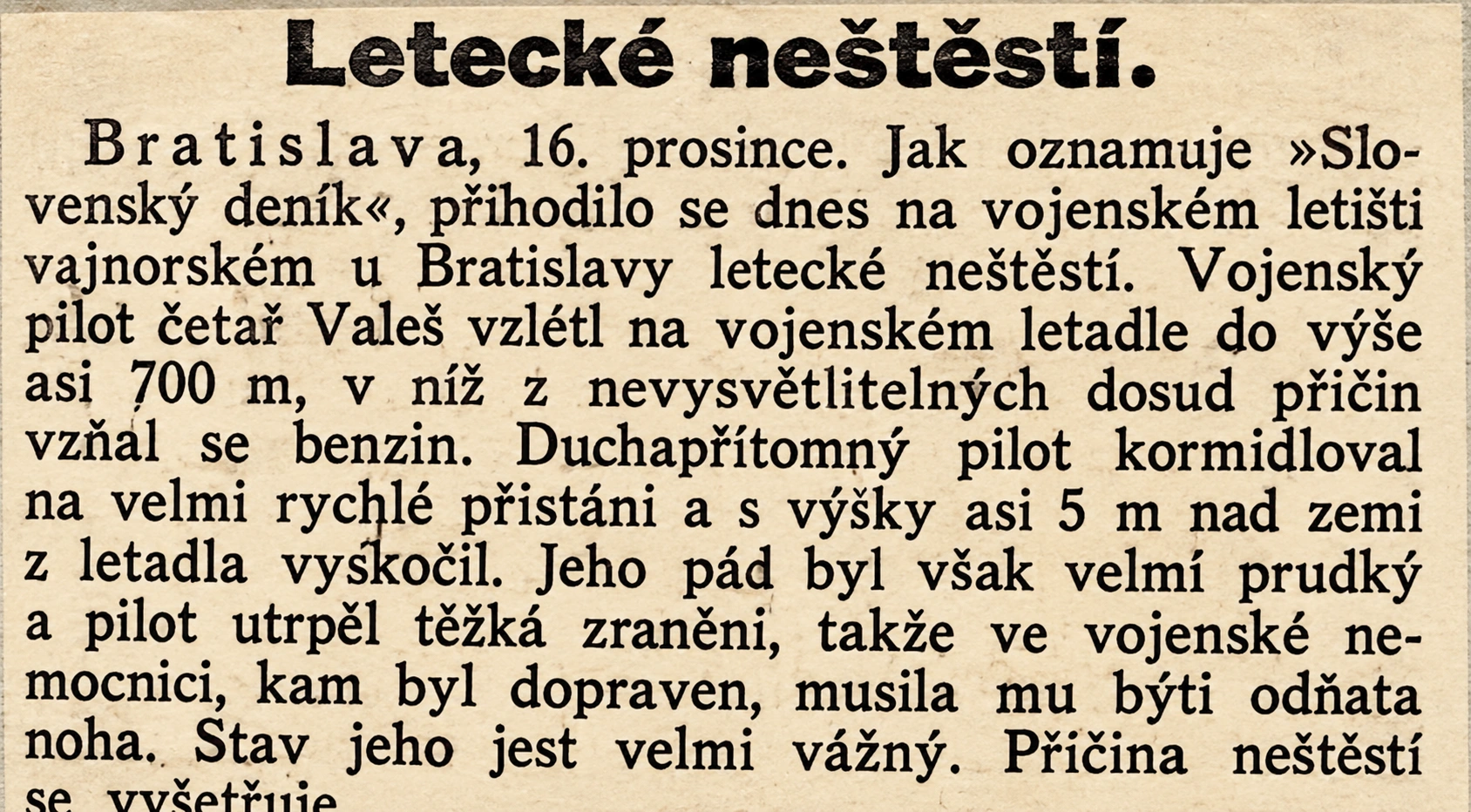
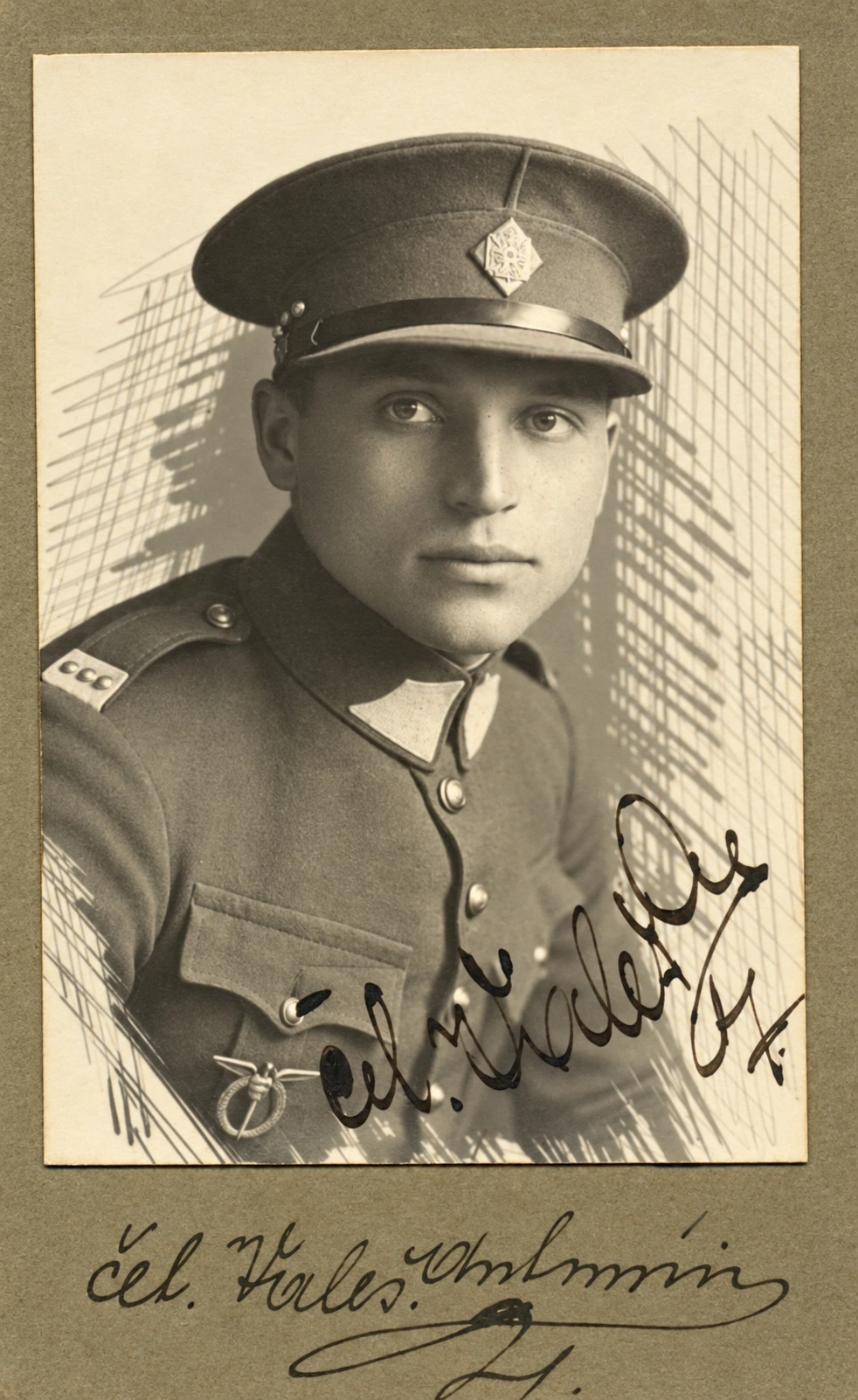
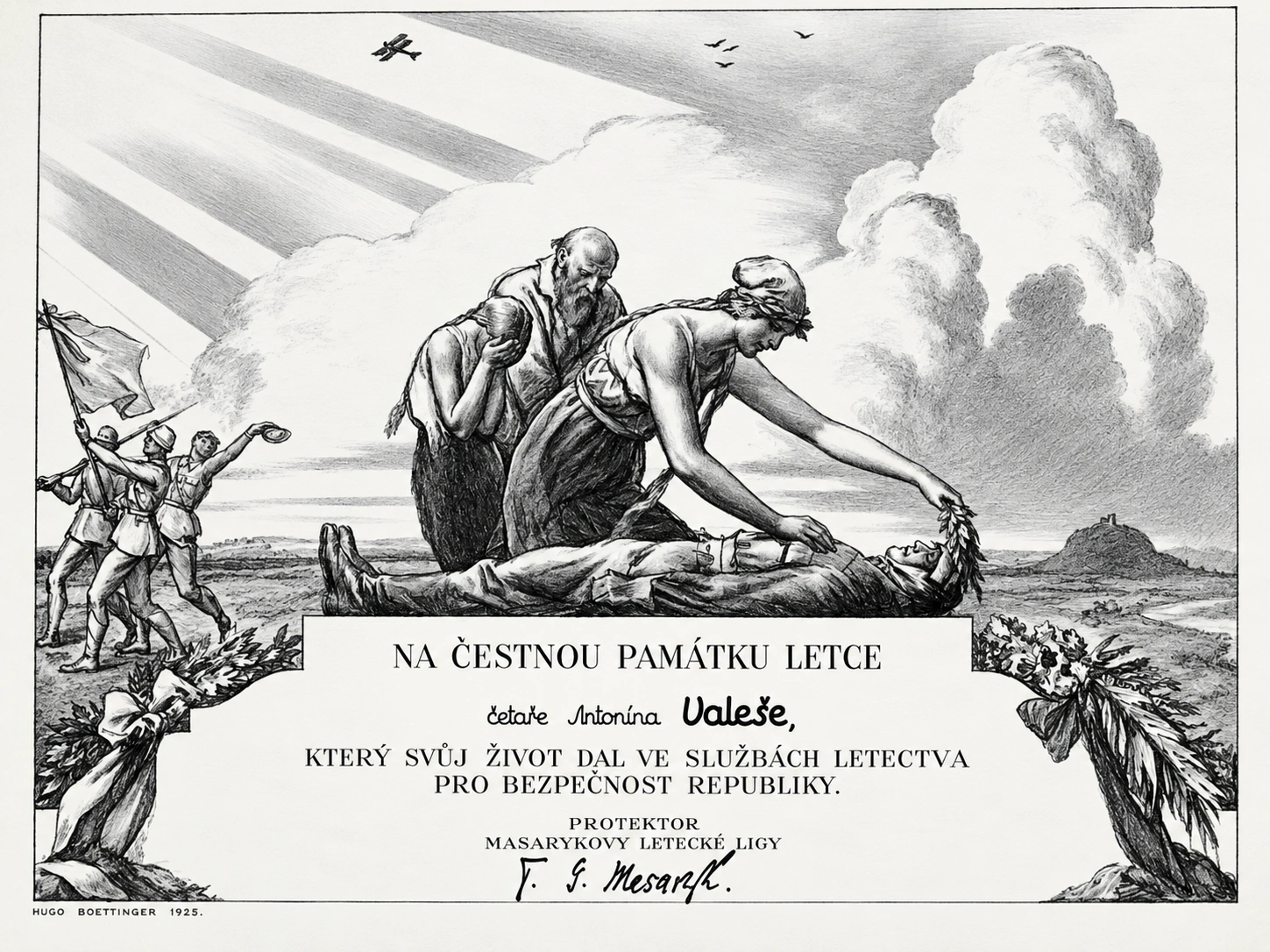
Sgt. Antonín Valeš (* 1902, Týnec, now Panenský Týnec, Louny district, Czech Republic; † 16.12.1926, Bratislava) has a memorial near Gen. Štefánik’s monument in Ivanka pri Dunaji, at the site of the fatal crash of 16 December 1926. That day he was training near Bratislava in Avia B.21.63 as a member of No. 31 Fighter Squadron based at Vajnory. The squadron belonged to II Wing, headquartered at Vajnory, subordinate to the Gen. M. R. Štefánik 3rd Air Regiment, headquartered in Nitra.
At approximately 700 m, the aircraft’s fuel caught fire. The pilot attempted a forced landing in the burning machine. At about five metres above ground near what was then Bratislavská Ivánka, now Ivanka pri Dunaji, he jumped out and was gravely injured. At Divisional Hospital 9 in Bratislava, his leg was amputated, but he died the same day from multiple injuries. He was buried with military honours at Panenský Týnec cemetery on 23 December 1926.
Members of the Bratislava branch of the Gen. Dr M. R. Štefánik Slovak Aviation Union initiated and completed the memorial’s restoration in 2011, with substantial funding from Slovakia’s Ministry of Defence, Air Navigation Services of the Slovak Republic, and aviation-history enthusiasts from Ivanka pri Dunaji.
source - vets.cz
What about parachutes in 1926?
Although modern back and seat parachutes, including American Irvin parachutes, already existed and were technically advanced, several problems accompanied their introduction into routine use:
- Not compulsory equipment: In Czechoslovak military aviation in 1926, parachutes were not yet universally compulsory for pilots on every training or routine flight.
- Military bureaucracy and distrust: Military commands in many countries, including Czechoslovakia, introduced parachutes only gradually. Early prejudice held that having a parachute might encourage pilots to abandon expensive aircraft prematurely rather than try to save them.
- The free-fall problem: Czechoslovak regulations did not yet routinely permit free-fall jumps, in which the pilot jumps and pulls the ripcord himself. Most systems still depended on static lines attached to the aircraft structure, an extremely dangerous arrangement in a burning aircraft. [1]
Widespread provision of domestically produced emergency parachutes to Czechoslovak military aviation followed only after Valeš’s accident. The domestic F. P. S. parachute underwent dummy tests in 1927 and test jumps by Alois Vrecl on 26 April 1928.
Who manufactured parachutes in Czechoslovakia, and which types?
PAK – Jan Popelák’s company, Prague-Holešovice. The domestic emergency parachute resulted from cooperation between Fiala, Popelák and Svoboda, whose initials formed F. P. S. After testing, Jan Popelák’s firm in Přístavní Street produced it under the PAK brand. It supplied Czechoslovak military aviation and exported it, particularly to Finland and Turkey. PAK therefore cannot simply be described as a licensed Irvin.
Jindřich Klinger, Bratislava. According to Air Regiment 3’s daily orders compiled by Viktor Timura, the company manufactured F. P. S. parachutes and, in 1935, Svět parachutes in versions Ia and Ib. That year both Klinger and Prague-based PAK were authorised to inspect parachute storage and packing directly at Air Regiment 3 squadrons. Vladimír Gajdoš describes Svět as a licensed Irvin; the cited daily orders themselves do not establish the precise licensing relationship.
Sources: VHÚ Praha, Historie a vojenství 1/2018; Viktor Timura, Červené barety 3/2013; Vladimír Gajdoš: Pozor, skáču veteráni! (2017).